
Owning Your Brand Story Will Drive Big Growth in 2026

Updated: Mar 20
In most leadership meetings, “brand” still gets brought up as a side topic. Someone in marketing makes the case, a few people nod, and then someone says, “We don’t need to spend on logos and taglines right now—we need sales.”
This is a huge missed opportunity that is costing companies real money.
Brand is not a logo. It’s not a tagline. It’s the strategic foundation that shapes how people perceive, choose, and stay with your business. In 2026, with AI changing how customers discover, compare, and buy, owning your brand story is no longer a “nice-to-have”—it’s a direct growth lever.
When you treat brand as central to the business (not a marketing accessory), you:
Shorten sales cycles
Increase conversion rates
Command better pricing
Improve retention and lifetime value
Lower acquisition costs
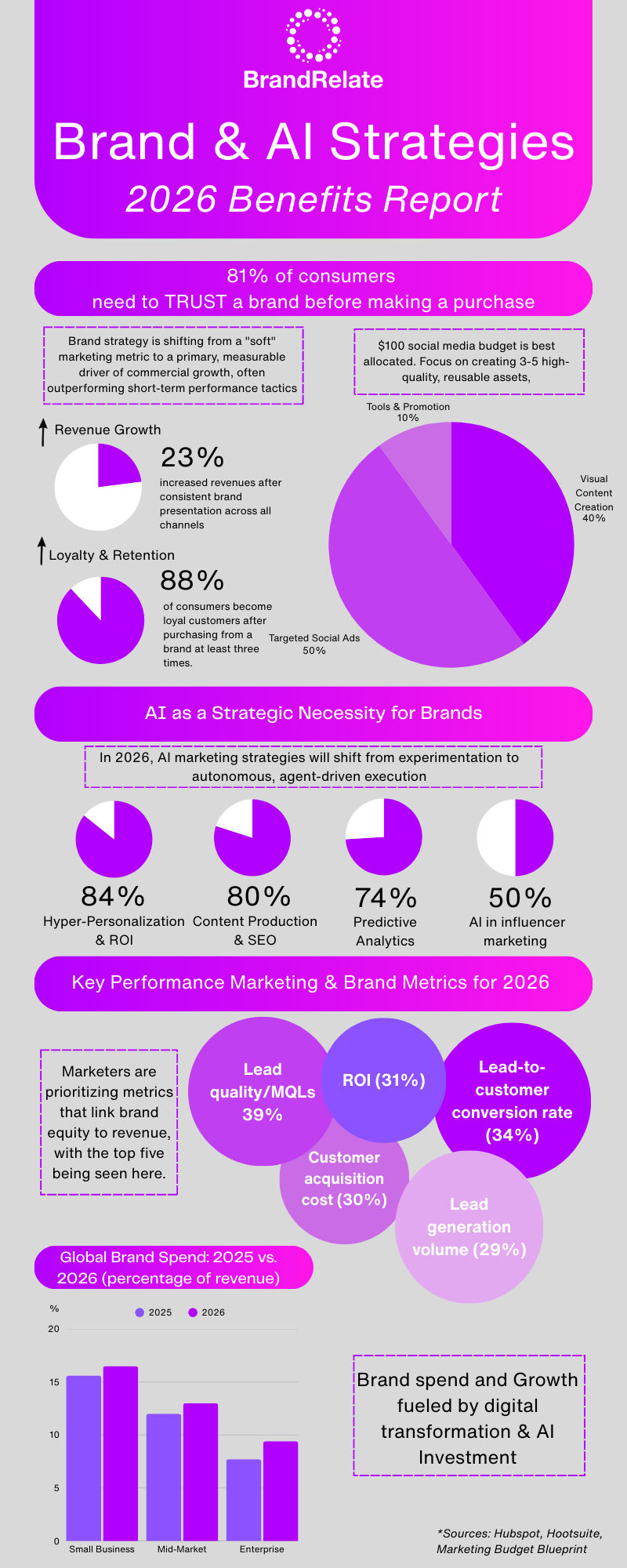
Below is a results-focused view of brand and AI strategies, and how they translate into tangible outcomes like increased revenue, sales, and awareness.
1. Authenticity & Purpose = Trust = Higher Conversion & Retention
Start with two questions:
Who are we (really)?
What problem do we actually solve (better than others)?
Defining a clear mission, values, and purpose—beyond “we sell X”—creates an emotional and rational reason to choose you over a competitor.
Why does this really matter?
Brands seen as authentic generate higher willingness to pay and more repeat purchases. Clear purpose simplifies decision-making for customers: “Are they for people like me?” Trust reduces friction in the funnel: fewer objections, less discounting, faster close.
When customers believe your story and see it reinforced in your product, service, and behaviour, they buy more—and they come back.
2. Storytelling with Emotion = Brand Preference = Higher CLV
Your brand story is the narrative that answers: Why do we exist and why does it matter to our customers?
Companies like Apple don’t just sell phones; they sell creativity, status, and seamless experiences. That emotional frame justifies premium pricing and creates loyalty that survives feature comparisons.
What does this unlock?
People remember stories, not features. Emotional narratives increase recall and preference. Tighter emotional connection leads to higher customer lifetime value, more organic word-of-mouth,and lower churn during competitive promotions.
You’re not just building a brand to win a single transaction—you’re building one that stays “sticky” over time.
3. Product & Service Differentiation = Faster Sales Cycles
Differentiation is answering: “Why you, not them?” in a simple, compelling way.
By clearly articulating what you do uniquely—whether that’s speed, quality, specialization, or service—you make it easier for customers to say yes.
What’s the impact on growth?
Shorter sales cycles (less time spent explaining and defending value). Higher close rates versus undifferentiated competitors. Less pressure to compete purely on price.
A sharpened brand story functions like a “shortcut” in your prospect’s mind: “They’re the ones who do X better than anyone.”
4. Brand Positioning & Architecture = Market Clarity = Scalable Growth
Brand positioning is how you want to be perceived in the market relative to competitors (e.g., premium, innovative, simplest, most ethical).
Brand architecture is how your product offerings and sub-brands fit together:
Branded House (e.g., FedEx): One strong master brand across offerings. Efficient marketing spend and faster trust transfer to new products.House of Brands (e.g., P&G): Many distinct brands under one corporate umbrella. Allows targeting different segments with different promises and reduces risk when expanding into very different categories.
What are the business outcomes?
Clearer positioning improves recall and preference when customers are ready to buy. A smart architecture avoids confusing customers, which directly impacts conversion. Efficient brand structure reduces marketing waste and accelerates go-to-market for new products.
5. Brand Experience = Trust at Every Touchpoint = Higher Conversion
Brand isn’t what you say—it’s what customers experience.
From website and product UX to packaging, customer service, and social content, every interaction either reinforces or erodes your story.
Why does it matter?
Consistency builds recognition (faster trust, lower hesitation). Positive experiences turn first-time buyers into repeat customers. Seamless experiences (online + offline) increase basket size and CLV.
When your brand story, visuals, tone, and service are aligned, you don’t have to “sell” as hard. The experience does the heavy lifting for you.
6. Visual Identity = Recognition = Lower Acquisition Costs
A cohesive visual system—logo, colours, fonts, imagery, layouts—is not “fluff.” It’s how your brain gets a shortcut to recognition.
What’s the value to the business?
Faster recognition → more effective advertising impressions. Consistent design across channels → improved trust and professionalism. Strong visual equity → more efficient media spend over time (you don’t reintroduce yourself with every campaign).
Consistency is not about looking pretty—it’s about being easily recognized and remembered in crowded markets.
7. Price-Based Positioning = Margin Strategy, Not Just “Cheap or Expensive”
Price is a powerful brand signal. Are you the most affordable, the best value, or the premium leader?
Your brand story must support this position, or customers will question your pricing.
What are the impacts of price?
Clear price-based positioning sets expectations and reduces negotiation. A strong brand allows for higher margins (people pay for trust, design, and experience). Value-based positioning (not just cheapness) protects you when competitors race to the bottom.
8. Employee Advocacy & Authenticity = Reach & Credibility at Scale
People trust people more than logos. Encouraging employee voices (on LinkedIn, social content, blog posts, podcasts) turns your team into a distributed brand engine.
Why does this boost results?
Employee content drives higher engagement and reach than corporate channels alone. Authentic, human voices increase credibility in B2B and B2C buying decisions.
Prospects perceive “real people who care” behind the brand, reducing perceived risk.
Companies like Microsoft have leveraged employee voices to humanize the brand and build trust in complex, technical categories.
9. PR & Reputation Management = Visibility + Risk Protection
PR is not just about vanity placements. It’s about shaping perception in the channels your buyers trust—media, analysts, events, podcasts, and thought leadership.
What’s the business impact?
Earned media increases awareness at a fraction of paid media cost. Strong reputation reduces damage in times of crisis (faster recovery, less revenue loss). Third-party validation (press, analysts, partners) directly influences purchase decisions, especially in B2B and high-consideration B2C.
10. AI-Powered Hyper‑Personalization = Higher Conversion & Revenue per Customer
AI allows you to move beyond generic campaigns to truly individualized experiences.
By analyzing browsing behaviour, purchase history, and engagement patterns, AI can serve tailored product recommendations, trigger personalized emails and offers and adapt website content in real time.
What are the measured outcomes?
Higher click-through and conversion rates. Increased average order value through smart upsell/cross-sell. Lower cart abandonment when combined with behavioural triggers.
Personalization is no longer optional. Customers expect it, and it directly lifts revenue.
11. Predictive Analytics = Smarter, Proactive Growth Strategy
AI is shifting marketing from reactive to proactive.
By analyzing historical and real-time data, predictive models can forecast demand and seasonality, identify high-value segments and lookalike audiences, flag churn risks before they leave and suggest optimal timing and channels for campaigns.
What’s the business impact?
Better allocation of media budget → higher ROI. More accurate inventory planning → less overstock and lost sales. Targeted retention campaigns → improved lifetime value and lower churn.
This is where brand and AI intersect: your brand story defines who you want to attract and keep; AI helps you find and convert them more efficiently.
12. Brand Monitoring & Sentiment Analysis = Faster Response, Protected Revenue
AI tools now continuously track mentions of your brand across social media, reviews, forums, sentiment (positive, neutral, negative), emerging issues or recurring complaints.
Why does this matter to revenue?
Early detection of issues prevents PR crises and boycotts. Fast, informed responses improve customer satisfaction and loyalty. Insights from real customer language feed back into brand messaging and product improvements.
A strong brand story is not static—you refine it based on real-time customer sentiment and behaviour.
13. AI-Assisted Content & Creative = More Effective Storytelling, at Scale
Generative AI can help teams produce on-brand copy variations for ads, emails, and landing pages, localized content for different regions or segments and rapid A/B test concepts to find what resonates.
How does this affect the bottom line?
More tests → faster learning → higher-performing campaigns, higher relevance across segments → better engagement and conversion and strategic time freed up for teams to focus on insight and creativity, not just production.
AI doesn’t replace brand strategy—it amplifies it when the story is clear.
So, Why Does This Matter in 2026?
In an AI-driven, content-saturated world, if you don’t own your brand story, algorithms and competitors will define it for you.
Leaders who dismiss “brand” as logos and taglines are leaving money on the table.
The companies that win in 2026 will be those that:
Define a clear, differentiated brand story
Embed that story across product, experience, and culture
Use AI not as a gimmick, but as a force multiplier for relevance, personalization, and insight
How to Push Back Internally (and Tie Brand to Revenue)
When you’re challenged with “Why invest in brand?” anchor your response in outcomes:
“A clearer brand story will shorten our sales cycle by making our value proposition obvious.”
“Consistent experience and personalization will increase repeat purchase and lifetime value.”
“Investing in positioning lets us defend or increase margins instead of discounting.”
“AI-powered personalization and predictive analytics will grow revenue per customer and reduce churn.”
Owning your brand story isn’t about cosmetics, it’s about controlling the narrative that drives awareness, choice, loyalty, and ultimately, revenue.
By reclaiming your story, and pairing it with intelligent AI strategies, you turn “brand” from a soft concept into one of your most measurable growth engines in 2026.
Written by: BrandRelate Team


Comments